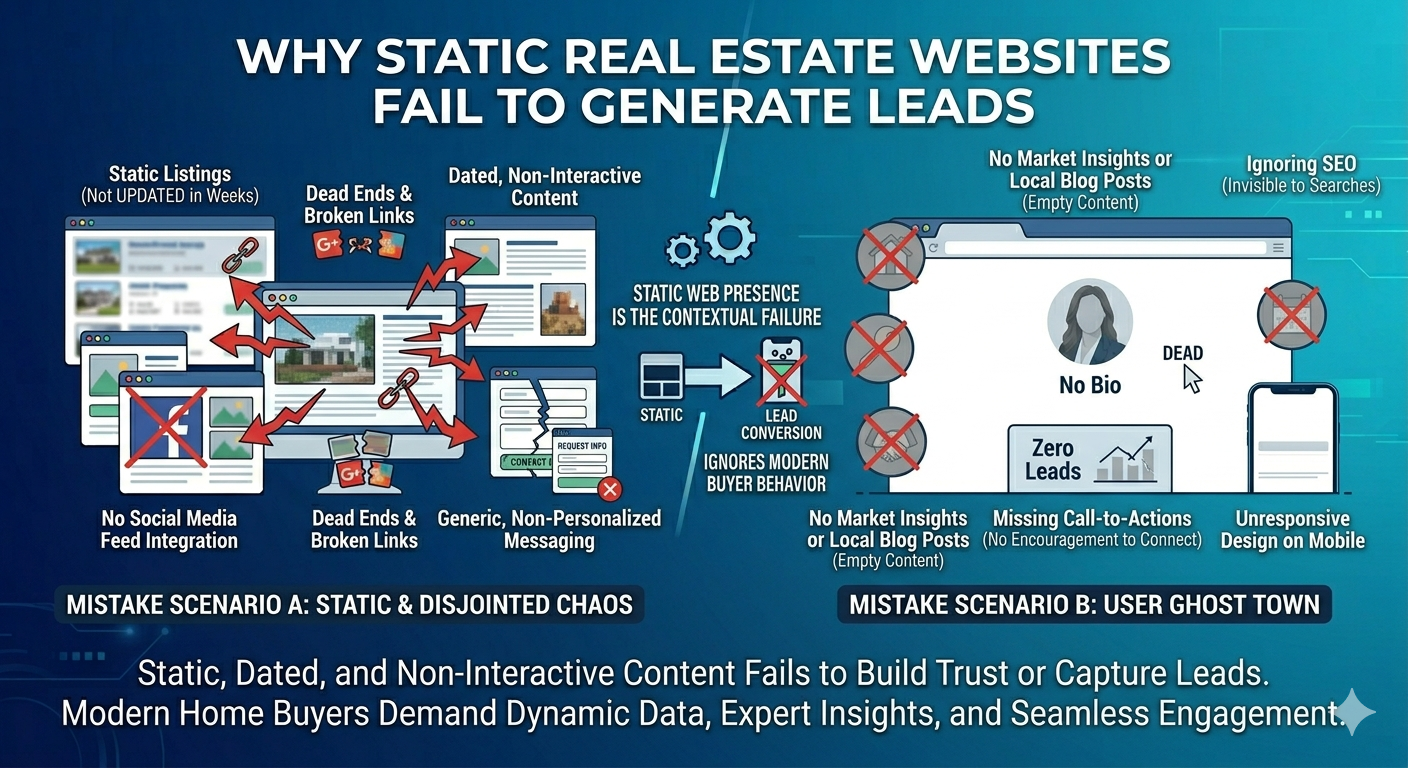
For years, real estate agents have invested in static websites believing that simply “being online” would generate leads. These websites typically contain fixed pages such as Home, About, Services, Listings, and Contact, with little to no interaction or ongoing updates. While this approach may have worked in the past, it no longer delivers results in 2025.
Buyer behavior, search engine algorithms, and digital expectations have changed. Today, static real estate websites often fail to attract traffic, build trust, or convert visitors into leads. This blog explains why static real estate websites struggle to generate leads and what agents should understand about modern online presence.
What Is a Static Real Estate Website?
A static real estate website is a website where content rarely changes and user interaction is minimal. These websites usually:
-
Have fixed text and images
-
Do not update listings frequently
-
Lack interactive features
-
Offer limited personalization
-
Rely on basic contact forms
While static websites are simple to create, they are not designed to engage modern buyers or adapt to digital trends.
Buyers Expect Dynamic and Interactive Experiences
Modern buyers expect more than information; they expect engagement. Property buyers want to explore, compare, interact, and get instant responses.
Static websites fail because they:
-
Do not respond to user behavior
-
Offer no interactive tools
-
Lack real-time updates
-
Feel outdated and inactive
When buyers land on a static website, it often feels abandoned or irrelevant. This creates doubt and reduces the likelihood of making contact.
Static Content Does Not Build Trust
Trust is critical in real estate, and static websites struggle to establish it. Buyers want evidence of activity, experience, and reliability.
Common trust-related issues with static websites include:
-
Old or outdated listings
-
No recent testimonials
-
No visible activity or updates
-
Generic content that feels copied
A website that looks unchanged for months signals inactivity. Buyers assume the agent may not be active or responsive, leading them to move on to competitors.
Poor Performance in Search Engines
Search engines favor websites that are fresh, relevant, and regularly updated. Static real estate websites often fail to meet these criteria.
Key SEO problems include:
-
No new content for search engines to index
-
Limited keyword coverage
-
No local market updates
-
Weak internal linking structure
As a result, static websites rank poorly for important searches such as “real estate agent near me” or “buy property in [city].” Without traffic, lead generation becomes impossible.
Lack of Clear Conversion Paths
Many static websites provide information but fail to guide visitors toward action. They often include a single contact page and assume visitors will reach out on their own.
This approach fails because:
-
Buyers need prompts and guidance
-
Contact options are limited
-
Calls to action are weak or missing
Without clear next steps, even interested visitors leave without converting into leads.
No Personalization for Different Buyer Types
Buyers have different needs depending on their intent. First-time buyers, investors, sellers, and renters all look for different information.
Static websites treat all visitors the same. They do not:
-
Adapt messaging based on intent
-
Highlight relevant services dynamically
-
Segment visitors by interest or location
This one-size-fits-all approach reduces relevance and lowers conversion rates.
Static Websites Fail on Mobile Engagement
Mobile users dominate property searches. While some static websites may be responsive, they often lack mobile-focused features.
Common mobile shortcomings include:
-
Slow loading speed
-
Poor navigation
-
Hard-to-click buttons
-
Long text blocks
If a mobile visitor cannot quickly call, message, or submit an inquiry, the lead is lost. Static websites are rarely optimized for mobile-first engagement.
Limited Lead Capture Capabilities
Modern lead generation requires multiple touchpoints. Static websites often rely on a single contact form, which is not enough.
They usually lack:
-
Click-to-call buttons
-
WhatsApp or messaging integration
-
Live chat or quick inquiry options
-
Appointment booking tools
This limits how and when leads can engage, reducing overall conversions.
No Social Proof Integration
Social proof plays a major role in buyer decision-making. Reviews, testimonials, and ratings increase credibility and confidence.
Static websites often:
-
Do not display reviews
-
Show outdated testimonials
-
Lack third-party validation
Without visible social proof, buyers hesitate to trust the agent, especially when comparing multiple options online.
High Maintenance With Low Returns
Ironically, static websites still require maintenance. Domains must be renewed, hosting must be paid for, and security updates are necessary.
The problem is that:
-
Costs continue
-
Performance remains low
-
Leads do not increase
This creates frustration for agents who invested money but see little return on investment.
Buyers Prefer Platforms and Profiles Over Static Sites
In 2025, buyers are more comfortable with platforms that feel active, structured, and verified. Digital profiles and dynamic platforms feel more trustworthy than isolated static websites.
Buyers prefer:
-
Profiles with clear, verified information
-
Platforms with visible activity
-
Easy-to-access contact options
-
Consistent presentation
Static websites feel disconnected from this ecosystem, making them less appealing.
Static Websites Do Not Support Modern Marketing
Digital marketing today relies on data, behavior tracking, and optimization. Static websites provide little insight into visitor behavior.
They lack:
-
Advanced analytics
-
Conversion tracking
-
Behavioral insights
-
Optimization flexibility
Without data, agents cannot improve performance or understand why leads are not converting.
Why Static Websites Fail to Convert Traffic Into Leads
Even when static websites receive traffic, they struggle to convert it. The reasons include:
-
Weak calls to action
-
No urgency or engagement
-
No follow-up mechanisms
-
Poor user experience
Lead generation requires interaction, not just information.
What Works Better Than Static Websites
Modern real estate professionals are shifting toward:
-
Dynamic websites
-
Platform-based digital profiles
-
Interactive landing pages
-
SaaS-driven online presence
These solutions offer:
-
Built-in SEO
-
Mobile-first design
-
Trust signals
-
Easy lead capture
-
Continuous updates
They align better with buyer expectations and modern search behavior.
Conclusion
Static real estate websites fail to generate leads because they no longer match how buyers search, evaluate, and engage online. They lack interactivity, freshness, trust signals, and conversion-focused design.
In 2025, real estate lead generation requires dynamic, engaging, and trust-driven digital presence. Agents who rely on static websites risk invisibility, low engagement, and missed opportunities.
A successful online presence must evolve continuously, guide visitors clearly, and build trust instantly. Static websites, by their nature, cannot meet these demands—making them ineffective for modern real estate lead generation.
💡Description : Learn why static real estate websites fail to generate leads in 2025 and what modern agents need to build trust, engagement, and conversions online.
✨ Tags : static real estate website, real estate website lead generation, agent website failures, real estate digital marketing mistakes, why agent websites fail, real estate online presence 2025